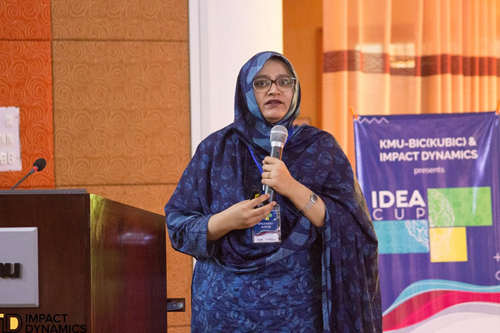
In this latest series of articles, we publish interviews with women working as professionals or students in the technology sector. The objective is to highlight their work and contribution to the industry and the community.
In these interviews, you will find women working in technology to solve real-world problems, break stereotypes, and create the next big impact on the tech industry. This series of interviews shows that even with the lowest rate of women’s participation in the labor market in Pakistan, there are still many smart women who are creating and using technology to work wonders.
Today, we are featuring Tooba Khan. Read on to learn more about her work and get inspired.
1. Tell us a little about yourself, your background, your education, and your work.
This is Tooba Khan here, a Software Engineering graduate who chose to take her analytical brain and pair it with a love for creativity, community building, and designing experiences. My professional journey has been anything but linear. From co-founding a student career-awareness platform to managing high-stakes tech hackathons, from writing for Dawn’s Young World Magazine to designing entrepreneurship bootcamps, I’ve found myself at the intersection of technology, people, and ideas.
Currently, I’m the Community & Outreach Specialist at the National Incubation Center Karachi, where I connect founders, investors, corporates, and academia, and design programs that help ideas become sustainable businesses. My work is equal parts strategy, enabling partnerships, relationship building, and creating environments where innovation can thrive.
2. What are your future plans/aspirations? How will it impact the community/society/your team/your project?
In the long term, I aim to focus on developing programs and platforms that bridge the intersection of technology, community, and creativity. Specifically, I envision myself designing initiatives that make entrepreneurship accessible to students outside traditional networks, creating pipelines that help women in tech grow into leadership roles without having to compromise their identity, and utilizing design and storytelling to transform abstract ideas into solutions that people can actually use.
I’ve felt what it’s like to be stuck on the outside, and how life-changing it is when even one person opens a door. My work is about making that the norm: ecosystems where support, mentorship, and opportunity are expected, not accidental.
For me, community and work are inseparable. Whether through incubation programs, bootcamps, or creative collaborations, my direction is to keep building structures that open doors, connect people deeply, and make innovation feel human and accessible. That’s what keeps me moving forward.

3. Please brag about your career accomplishments. What are the things you are proud of?
At NIC Karachi, I’ve helped design the How to Build a Startup Bootcamp to help people navigate the basics of their business. Also launched multiple flagship programs like,
- From Freelancer to Founder Bootcamp Series with PAFLA
- Code to Create Workshop Series with Google Developers Group, aka GDG Kolachi
- Product Sprint Bootcamp with Product Soch
- Masterclass for Tech Founders with PASHA
I have also:
- Co-Managed high-impact hackathon BuiltByHer for female founders, a collaboration between The Asia Foundation, LMKT, and NIC Karachi.
- Contributing as a Program Operations Lead for XSeed, a startup incubation program in collaboration with INSEAD Business School, LMKT, and NIC Karachi.
- Wrote for Dawn’s Young World magazine, which gave me the joy of seeing my words inspire younger audiences.
- Mentored students through The Citizen Foundation’s Rahbar Programme, blending professional skills with community responsibility.
- I’ve managed over 700+ events and facilitated 100+ investor and corporate meetings for startups.
- Represented NIC Karachi at collaborations with global and national giants, Google Cloud, INSEAD Business School, PASHA, The Asia Foundation, and the U.S. Consulate.
- Increased NIC Karachi’s footfall by over 60% during my tenure.
4. What has been your best education/career decision, and why?
Choosing not to limit myself to “pure tech” roles despite having a Software Engineering degree. I leaned into the intersection of tech, creativity, and human connection. It gave me the freedom to design programs, lead teams, and still speak the language of tech founders, making me both a bridge and a builder in the ecosystem.
5. What are the best lessons you’ve learned?
- Creativity isn’t just art; it’s in designing processes, experiences, and solutions. Sometimes the most “creative” act is making a chaotic project flow.
- As author Dale Carnegie taught, the best connections come when you give value with genuine curiosity, not when you’re just collecting LinkedIn contacts.
- Chasing sunsets reminds me there’s more to life than deadlines; the best ideas often arrive away from the laptop.
- Always document your work; memory fades, impact doesn’t. Your future self will thank you.
- Don’t wait to feel “ready”, some of my proudest moments came from saying “yes” before I could talk myself out of it.
- As Robin Williams’ character said in Dead Poets Society: “Medicine, law, business, engineering, these are noble pursuits… But poetry, beauty, love… these are what we stay alive for.”
- Skill and efficiency keep the machine running, but meaning makes the ride worth it. For me, that beauty is in sparking real connections, creating learning experiences, and making workspaces feel human. We’re not just building careers, we’re building lives.
6. Which woman inspires you and why?

Last year, I took Elizabeth Gilbert’s online course on Acumen Academy, where she spoke about creativity without fear and the art of balancing ambition with grace, not just as the author of Eat, Pray, Love, but as a thinker who lives her craft. Through that course, I learned that creativity isn’t a luxury; it’s a discipline, a truth that now shapes how I work and live.
Closer to home, Faiza Yousuf inspires me as a woman in tech, a writer, and a community builder. I first discovered her during my university years, stuck in a project management course. On a whim, I reached out, expecting silence, but she replied. That act of generosity reshaped how I view accessibility, mentorship, and paying it forward.
Shamim Rajani, another powerhouse in tech, inspires me through something many might overlook: her impeccable dressing style and the way she carries herself. She’s a living reminder that no matter how modern, technological, or global we become, holding our traditions close adds depth and identity to our journey.
From my own work experience, my former manager, Sana Shah, now the Project Director of NIC Hyderabad, has been an invaluable example. Her ability to get work done efficiently, effectively, and without unnecessary noise is something I deeply admire. Her gift for building meaningful, authentic relationships stands out in a world full of surface-level connections.
7. Do you think Pakistan has changed as a society in terms of accepting career-oriented women? What needs to change to help more women come forward?
There has been progress; more women are visible in leadership, tech, and entrepreneurship than a decade ago. But societal acceptance often comes with caveats: “as long as it doesn’t disrupt family expectations” or “as long as it looks acceptable.” To bring more women forward, we need better childcare systems, safe transport, and workplaces designed for inclusion, not just in papers, but in daily actions.
8. What will be the biggest challenge for the generation of women behind you?
I think it will be navigating an overwhelming number of opportunities, the paradox of choice. They will have more platforms, tools, and paths than we did, but will need to learn how to filter noise, focus on their voice, and protect their mental well-being in an always-on digital world.
9. What would it be if you could change one thing about the tech industry/business?
I’d dismantle the “tech is only for coders” mindset. Tech is vast; it needs designers, storytellers, community managers, behavioral scientists, and strategists just as much as it needs engineers. We limit innovation when we limit who we think belongs.
I’ve seen firsthand how powerful it is when people from diverse skill sets step into tech spaces, whether it’s artists making interfaces more human, writers shaping product narratives, or community builders creating ecosystems that allow innovation to flourish. I’ve watched talented individuals shy away from opportunities because they thought, “I’m not technical enough”. The truth is: the future of tech will be built by multidisciplinary teams, not just developers.
10. How can WomenInTechPK help you and other women?
By continuing to do what it does best, it creates spaces where women can share opportunities, ask “naive” questions without judgment, and form collaborations that lead to real change. For me personally, I’d value structured mentorship programs and introductions to global networks so we can plug Pakistani talent into international ecosystems.
When I was in university, I remember feeling like the tech space was this intimidating, gate-kept circle. WomenInTechPK was one of the first communities where I saw women openly helping each other without ego or competition. That kind of environment makes you believe you do belong.
For me, a structured monthly program with mentorship that’s both skill-based and confidence-building would be a game changer. Also, more initiatives that highlight non-linear career paths in tech, so women can see that their skills, whether in management, storytelling, or community building, are just as vital to the industry’s growth as coding.
You can follow Tooba Khan using her profile(s) below, and please do not hesitate to hire her for your next project.
LinkedIn: https://www.linkedin.com/in/tk-toobakhan/
Dawn Writing Column: dawn.com/authors/9187/tooba-khan