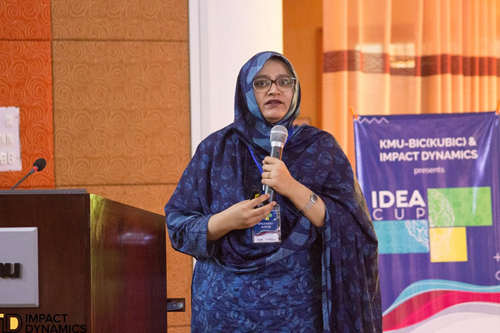
In this latest series of articles, we publish interviews with women working as professionals or students in the technology sector. The objective is to highlight their work and contribution to the industry and the community.
In these interviews, you will find women working in technology to solve real-world problems, break stereotypes, and create the next big impact on the tech industry. This series of interviews shows that even with the lowest rate of women’s participation in the labor market in Pakistan, there are still many smart women who are creating and using technology to work wonders.
Today, we are featuring Talia Khalid. Read on to learn more about her work and get inspired.
1. Tell us a little about yourself, your background, your education, and your work.
I am a performance-focused Monitoring & Evaluation Specialist at NIC Karachi, Pakistan’s largest tech incubator, where I work at the intersection of innovation, policy, and strategy. My journey began with a passion for driving measurable change in development and entrepreneurship. To strengthen my impact, I pursued advanced training in data analytics, enabling me to transform complex data into actionable strategies that influence programs and policy decisions.
For me, education provided the foundation, but my professional experience taught me that innovation must be inclusive, sustainable, and measurable to create lasting societal impact.

2. What are your future plans/aspirations? How will it impact the community/society/your team/your project?
My long-term aspiration is to lead high-impact, cross-border initiatives that position Pakistan’s innovation ecosystem on the global stage. I want to bridge local talent and international markets by designing programs and policies that open doors for startups — particularly women-led and ESG-focused ventures — to access funding, mentorship, and partnerships beyond borders.
In the next phase of my career, I aim to expand the scope of the councils I lead, creating sustainable pipelines for innovation in sectors like Fintech, social entrepreneurship, and corporate innovation. By embedding data-driven decision-making into every step, I envision a more resilient ecosystem where ideas don’t just survive but scale globally.
The impact I seek is multifold: empowering entrepreneurs to compete internationally, enabling corporates to adopt sustainable innovation practices, and ensuring women in tech are not just participants but leaders. This ripple effect — from startups to communities — will foster job creation, knowledge exchange, and inclusive economic growth.
3. Please brag about your career accomplishments. What are the things you are proud of?
At NIC Karachi, I have been instrumental in building the institutional framework for innovation. I conceptualized and developed 11 Tech Councils — multi-stakeholder platforms that bring together startups, corporates, and policymakers to solve sector-specific challenges. I currently lead three — the Women in Tech Council, the Corporate Innovation Council, and the ESG Council — each driving strategic initiatives to advance diversity, sustainability, and corporate-startup collaboration.
Recognizing the need for structured founder support, I designed the core incubation curriculum and a specialized track for women-led startups. These programs focus on product-market fit, go-to-market execution, fundraising strategies, and investor readiness. I also oversee quarterly institutional reporting, develop M&E frameworks, set clear KPIs, and measure program performance and impact — ensuring that innovation is not just encouraged, but effectively scaled.
Beyond my core responsibilities, I have produced impact evaluation reports for programs such as Built by Her 4 and Impact Collective, and delivered strategic support for national-level initiatives like PUAN, the SME Summit by State Bank, and Ideathon. These projects have strengthened my expertise in translating vision into measurable, large-scale results.
Earlier in my career at TCS, I successfully led commercial projects with operational complexity and nationwide visibility. These included Hazir SabKuch, Hazir 60-Minute Delivery by SanaSafinaz, and Black Friday Sales, where I managed cross-functional teams to deliver under high-pressure, time-sensitive conditions.
In addition, I spearheaded the revamping of the company’s claims policy, streamlining processes for faster resolutions and higher customer satisfaction. My performance earned me multiple Employee of the Month awards — recognition of my ability to consistently deliver excellence and exceed expectations.
4. What has been your best education/career decision, and why?
The most transformative decision of my career was to intentionally combine Monitoring & Evaluation expertise with advanced data analytics. Early in my journey, I realized that measuring impact alone was not enough — real influence comes from anticipating trends, identifying systemic gaps, and using evidence to shape strategy before decisions are made. By adding data analytics to my M&E foundation, I moved from tracking results to driving them.
This dual capability enabled me to design predictive M&E frameworks that inform program pivots, secure stakeholder buy-in, and strengthen funding proposals with data-backed projections. It has been pivotal in refining NIC Karachi’s incubation model, ensuring our councils — including Women in Tech, Corporate Innovation, and ESG — operate with clear, measurable impact pathways.
Equally significant was my choice to step into ecosystem leadership rather than remain solely in program management. By establishing and leading councils, I moved into a position where I could shape policy dialogues, foster corporate-startup partnerships, and advocate for systemic change in Pakistan’s innovation landscape.
These decisions have elevated my work from operational excellence to ecosystem influence, creating ripple effects that extend from individual founders to national innovation policy.
5. What are the best lessons you’ve learned?
One of the most profound lessons I’ve learned is that impact is never accidental — it is engineered through strategy, consistency, and the right alliances. At NIC Karachi, leading multiple councils taught me that ecosystem change requires more than enthusiasm; it needs frameworks, stakeholder alignment, and persistence even when results are slow to show.
Another lesson is the importance of context in data-driven decision-making. Numbers can show growth, but they can also mask gaps if you don’t understand the market dynamics, gender barriers, or operational realities behind them. While building M&E frameworks for NIC Karachi, I learned that pairing analytics with on-the-ground insights produces strategies that actually stick.
Finally, I’ve learned that relationships are the most valuable form of capital in the innovation and policy space. I’ve seen projects succeed because trust existed — between a founder and an investor, between a startup and a corporation, or between government and the private sector. Technical expertise might open the door, but credibility and collaborative intent are what keep it open.
These lessons now shape how I design programs, lead teams, and build partnerships — ensuring that each initiative delivers measurable, scalable, and human-centered impact.
6. Which woman inspires you and why?
I draw immense inspiration from Dr. Shamshad Akhtar, Pakistan’s former State Bank Governor and a globally respected economist. Her career exemplifies how expertise, integrity, and strategic vision can coexist in positions of national and international influence. She navigated complex economic challenges with a balance of technical mastery and diplomatic skill — a combination I deeply admire.
What inspires me most is her ability to hold her ground in male-dominated spaces without compromising on substance or values. She didn’t just occupy leadership positions; she shaped them, leaving behind policies and reforms that had a lasting impact.
Her example resonates with my own journey — leading councils, influencing policy dialogues, and working to ensure women have a seat at the table in Pakistan’s innovation ecosystem. Like her, I believe leadership is not about visibility alone; it’s about leaving behind systems and frameworks that outlive the leader.
Dr. Akhtar’s career reinforces my belief that technical expertise, when paired with resilience and vision, can drive change that is both measurable and enduring — something I strive for in every project I take on.
7. Do you think Pakistan has changed as a society in terms of accepting career-oriented women? What needs to change to help more women come forward?
Over the past decade, I have witnessed a noticeable shift in Pakistan’s narrative around career-oriented women. While traditional gender norms remain deeply rooted, more women are entering and excelling in fields once considered exclusively male domains — from technology and finance to policy and entrepreneurship.
At NIC Karachi, I’ve seen this transformation firsthand. Women-led startups are not only participating but also winning national and regional competitions, securing international investment, and leading ESG-focused innovations. Programs like Women in Tech Councils, WomenX, WECREATE Pakistan, DICE Women Entrepreneurship Program, National Women’s Digital Network, and women-focused acceleration tracks are creating pipelines for female leadership in the innovation ecosystem.
Culturally, the conversation has evolved from whether women should work to how they can lead. There’s a growing recognition that women’s economic participation is not just a social imperative but an economic necessity. Yet, this progress is uneven — rural and underserved communities still face systemic barriers, from limited mobility to lack of access to finance and mentorship.
The change, however, is tangible. Ten years ago, a woman speaking in a boardroom might have been the exception; today, she’s increasingly expected to be there, contributing at par. This momentum needs to be sustained through policy reforms, targeted capacity building, and ecosystem-wide support so that career-oriented women are not just breaking ceilings — they are redesigning the room.
8. What will be the biggest challenge for the generation of women behind you?
The generation of women that follows us will inherit a world moving at breakneck speed — where AI, automation, and emerging technologies redefine careers overnight. Their challenge won’t just be keeping pace with this change; it will be doing so while dismantling the deep-rooted gender biases that still limit women’s voices, choices, and leadership.
They will need to become relentless learners, mastering new skills not once in a career but many times over. Yet technical expertise alone won’t be enough — they must also be bold advocates for fair policies, inclusive workplaces, and equal opportunities.
Their greatest test will be to ensure that progress in technology is matched by progress in equality. And in doing so, they won’t just adapt to the future — they will shape it, making it a place where no woman has to choose between her potential and her circumstances.
9. What would it be if you could change one thing about the tech industry/business?
If I could change one thing about the tech industry, it would be to make inclusion and ethics the foundation of innovation rather than an optional checkbox. In my work leading the Women in Tech, Corporate Innovation, and ESG Councils at NIC Karachi, I’ve seen how diverse perspectives can transform not just the solutions we build, but the way they impact society. Yet, too often, product design and business strategies are shaped without the voices of women, marginalized communities, or sustainability advocates in the room.
I believe technology should not just scale profits — it should scale access, opportunity, and positive impact. Embedding ethical frameworks and diverse representation from the earliest stages of ideation would ensure that innovation serves everyone, not just the most privileged. This is how we move from simply advancing technology to advancing humanity.
10. How can WomenInTechPK help you and other women?
WomenInTechPK can play a pivotal role by becoming the bridge between ambition and opportunity for women in technology across Pakistan. Beyond networking, it can serve as a platform for skill-building, mentorship, and visibility — ensuring that women are not just entering the industry, but thriving in leadership roles.
For someone like me, who leads the Women in Tech Council at NIC Karachi, such a platform can amplify the work we are already doing — from creating specialized curricula for women-led startups to fostering corporate collaborations that open real market access. Through Women in Tech, we have been able to pull women into leading roles within the industry and corporates, giving them the influence and authority to shape decisions and drive change.
By connecting women to industry leaders, global opportunities, and peer support, WomenInTechPK can help dismantle barriers, challenge biases, and create a culture where women are seen, heard, and trusted as innovators and decision-makers. When more women rise in tech, the industry becomes richer, more inclusive, and better equipped to solve problems that truly matter.
You can follow Talia Khalid using her profile(s) below, and please do not hesitate to hire her for your next project.