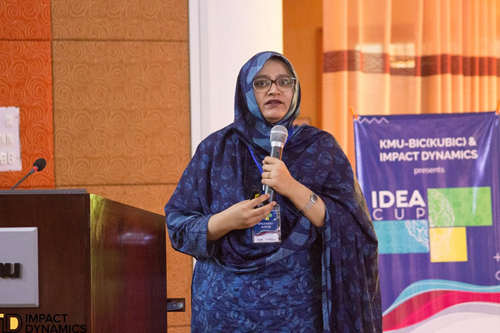
In this series, we publish interviews with women professionals working in technology. They are solving real-world problems, breaking stereotypes, and driving the next wave of innovation in the tech industry. Their stories reveal the depth of talent and ambition that exists within Pakistan’s tech community.
Pakistan has one of the lowest rates of women’s participation in its labor market. Yet smart women across the country are building and using technology to create meaningful impact. These interviews prove it.
Today, we’re featuring Bushra Javed. Read on to learn about her work and get inspired.
1. Tell us a little about yourself, your background, your education, and your work.
My journey into tech wasn’t just about choosing a career—it was about finding a space where I could solve real problems and create meaningful impact. With a background in Software Engineering. I started by building a strong foundation in both analytical thinking and technology, but it was through hands-on experience that I truly discovered where I thrive.
Over the past 8 years, I’ve worked across business analysis, product development, and digital solutions, collaborating closely with teams to turn ideas into functional, user-focused products. I’ve been involved in everything from understanding client needs and defining requirements to ensuring quality and delivering scalable web and mobile applications. One of the most exciting parts of my journey has been contributing to platforms like a laundry-tech marketplace, where I’ve played a role in shaping product features and improving user experience.

Being a woman in tech has shaped my perspective—it has pushed me to be more resilient, more curious, and more intentional about growth. I’m passionate about creating solutions that are not only efficient but also accessible and impactful. I’m also increasingly drawn toward entrepreneurship, exploring creative ventures that blend technology with everyday needs.
For me, tech is not just about systems and code—it’s about people, ideas, and the ability to build something that makes a difference. And I’m excited to continue growing, learning, and contributing alongside a community of inspiring women in this space.
2. What are your future plans/aspirations? What impact will it have on the community/society/your team/your project?
My future aspirations are centered around building technology that solves real, everyday problems while also creating opportunities for others to grow alongside me. I see myself evolving into a product leader and entrepreneur—someone who not only builds digital solutions but also shapes ideas into scalable, impactful businesses.
In the near future, I aim to deepen my expertise in product strategy and digital ecosystems, working on platforms that improve convenience and accessibility—especially in underserved or unorganized sectors. For example, through initiatives like marketplace-based solutions, I want to help small businesses and service providers digitize their operations, reach more customers, and operate more efficiently.
The impact I hope to create goes beyond just the product. For the community, it’s about enabling access—making services simpler, more reliable, and more inclusive. For society, it’s about contributing to digital transformation in a way that empowers local businesses and supports economic growth. Within my team, I want to foster a collaborative and growth-oriented environment where people feel encouraged to share ideas, take ownership, and continuously learn.

As a woman in tech, I also feel a strong responsibility to contribute to representation and mentorship. I want to inspire and support more women to step into technology roles, not just as participants but as leaders and creators.
Ultimately, my goal is to build solutions that are not only successful as products but meaningful in their impact—where technology genuinely improves how people live and work.
3. Please brag about your career accomplishments. What are the things you are really proud of?
I’m also proud to be building two startups that reflect my passion for solving real-world problems through technology.
StiffTech is focused on leveraging AI and digital solutions to address business challenges—whether it’s improving operational efficiency, building smarter systems, or helping companies scale through tech-driven strategies. The vision behind StiffTech is to not just deliver services but to create intelligent solutions that make businesses more agile and future-ready.
Alongside that, I’m working on Laundry X 360, a marketplace-driven platform aimed at transforming the laundry industry. This venture focuses on bridging the gap between traditional laundry operations and modern automation by streamlining processes like order management, tracking, and service delivery. The goal is to digitize and organize an otherwise fragmented sector, making it more efficient for businesses and more convenient for customers.
We are also proud to be incubated at NIC (National Incubation Center), which has provided us with valuable mentorship, ecosystem support, and guidance to further strengthen and scale our startups.
Both of these startups represent different sides of my vision—one rooted in advanced technology like AI, and the other in solving everyday operational challenges—and together, they reflect my commitment to building impactful, scalable solutions.

4. What has been your best education/career decision and why?
One of the best decisions I made for my career was choosing not to limit myself to a single role early on, and instead exploring different functions within tech—from business analysis and QA to product and client-facing work. While it might have seemed more straightforward to specialize quickly, this decision gave me a 360-degree understanding of how digital products are actually built, delivered, and scaled.
This cross-functional exposure has been incredibly valuable. It allowed me to connect the dots between business needs and technical execution, communicate effectively with both clients and development teams, and take ownership of products beyond just one phase of the lifecycle. It’s also what gave me the confidence to step into building my own ventures, like Stifftech and Laundry x360, because I understood not just the idea, but how to bring it to life end-to-end.
Beyond skills, this decision shaped my mindset. It made me more adaptable, more curious, and more resilient—qualities that are especially important as a woman navigating and growing in the tech industry.
Looking back, choosing growth over comfort and breadth over early specialization has had a lasting impact on my career, and it continues to influence how I learn, lead, and build.
5. What are the best lessons you’ve learned?
One of the most important lessons I’ve learned is that growth comes from stepping outside your defined role. Some of my biggest learning moments happened when I took ownership beyond what was expected—whether it was bridging communication gaps between teams, solving problems that weren’t “mine,” or stepping into unfamiliar responsibilities. That mindset helped me grow faster and build confidence in my abilities.
Another key lesson has been the importance of clarity and communication. In tech, even the best ideas can fail without proper understanding and alignment. I’ve learned that asking the right questions, simplifying complexity, and ensuring everyone is on the same page can make a huge difference in the success of a project.
I’ve also learned to embrace uncertainty. Working on products and startups like StiffTech and Laundry X 360 taught me that not everything will be perfectly planned—and that’s okay. Being adaptable, learning quickly, and staying solution-focused matters more than having all the answers upfront.

Finally, as a woman in tech, I’ve learned the value of believing in my voice. Speaking up, sharing ideas, and taking ownership of my work have been essential—not just for my own growth, but for contributing meaningfully to my team and the products I help build.
These lessons have shaped how I approach challenges today—with confidence, curiosity, and a strong focus on impact.
6. Which woman inspires you and why?
The women who inspire me the most are actually very close to me—my mother and my sister.
My mother has been a constant source of strength and resilience. She has always managed responsibilities with quiet determination, showing me what it truly means to stay committed, adapt to challenges, and keep moving forward regardless of circumstances. A lot of my work ethic and perseverance come from watching her.
My sister inspires me in a different but equally powerful way. Seeing her grow, take her own decisions, and navigate her path reminds me of the importance of independence and self-belief. It’s motivating to witness someone so close to me challenge norms and build her own identity.
Beyond my family, I’m deeply inspired by all women who are trying to build something for themselves—whether it’s in tech, business, or any field. Especially those who are stepping out of their comfort zones, breaking barriers, and pursuing their ambitions despite limitations. There’s something incredibly powerful about women who choose growth, take risks, and create opportunities—not just for themselves, but for others as well.
For me, inspiration isn’t just about big names or achievements—it’s about everyday courage, consistency, and the willingness to keep going. And I see that in the women around me every day.
7. Do you think Pakistan has changed as a society in terms of accepting career-oriented women? What needs to change to help more women come forward?
Yes, I do believe Pakistan has changed—there is definitely more acceptance today of career-oriented women than there was in the past. We’re seeing more women entering fields like technology, entrepreneurship, and leadership, and there’s a growing conversation around independence and financial empowerment. Families are becoming more supportive, and platforms for women to learn, work, and build careers are more accessible than before.
However, I think this progress is still uneven. In many cases, acceptance comes with conditions—women are often expected to balance professional growth with traditional responsibilities without the same level of structural support. There are still societal biases, safety concerns, and a lack of opportunities in certain areas that can hold women back from fully participating or advancing.
To help more women come forward, a few things need to change. Firstly, there needs to be stronger encouragement at the grassroots level—families and communities play a huge role in shaping whether women feel supported in pursuing careers. Secondly, workplaces need to become more inclusive by offering flexible policies, safe environments, and equal growth opportunities.
Equally important is representation and mentorship. When women see other women building careers, leading teams, or starting businesses, it makes those paths feel more achievable. Creating more platforms, networks, and communities where women can learn, connect, and support each other can have a powerful impact.
I also believe mindset is key—both at a societal level and individually. Encouraging women to believe in their capabilities, take risks, and own their ambitions is just as important as external support.
Overall, while progress is happening, there’s still a lot of work to be done. But with the right support systems and continued awareness, I believe we can create an environment where more women not only enter the workforce but truly thrive.
8. What will be the biggest challenge for the generation of women behind you?
I think the biggest challenge for the next generation of women will be navigating the balance between rapidly expanding opportunities and deeply rooted social expectations.
On one hand, there will be more access than ever before—education, online platforms, remote work, entrepreneurship, and global exposure will continue to grow. Women will have more tools to build independent careers and explore fields like technology, leadership, and innovation.
However, the challenge will lie in consistency and confidence within this space. Even with opportunities available, many women may still face subtle barriers—societal pressure to prioritize traditional roles, lack of mentorship in certain industries, and the internal struggle of self-doubt when stepping into competitive or male-dominated environments like tech.
Another key challenge will be keeping up with fast-changing skills. As technology evolves rapidly, continuous learning will be essential, and women will need strong support systems and access to upskilling opportunities to stay relevant and competitive.
To me, the most important part is not just entering these spaces, but staying in them, growing in them, and leading within them. That will require resilience, confidence, and environments that actively support women rather than just welcoming them in principle.
If we can strengthen mentorship, normalize women in leadership, and create more inclusive ecosystems, then the next generation will not just face fewer barriers—they will be able to redefine what success looks like entirely.
9. If you could change one thing about the tech industry/business, what would it be?
If I could change one thing about the tech industry, it would be the level of accessibility to real ownership and decision-making opportunities—especially for young professionals and women.
Right now, a lot of talent in tech is involved in execution, but fewer people are trusted early on with ownership of products, strategy, or meaningful decision-making. I believe innovation grows faster when people are given responsibility early, allowed to make mistakes, and encouraged to think like builders rather than just contributors.
For women in particular, this becomes even more important. There is often a gap between participation and leadership. While more women are entering tech, fewer are in roles where they are shaping product direction, leading teams, or making strategic decisions. Changing this would not only improve representation but also bring more diverse thinking into the core of how products and businesses are built.
I would also improve how success is defined in the industry. Instead of focusing only on titles or hierarchy, I would value impact, problem-solving ability, and initiative more strongly. This shift would encourage more innovation and allow people from non-traditional backgrounds to contribute meaningfully.
In my view, when people are trusted with responsibility early and evaluated on impact rather than position, the entire ecosystem becomes more dynamic, inclusive, and innovative.
10. How can WomenInTechPK help you and other women?
WomenInTechPK can play a very powerful role in helping me—and many other women—by creating a strong ecosystem of support, visibility, and opportunity within the tech industry.
For me personally, one of the biggest ways it can help is through mentorship and guidance. Having access to experienced women who have already navigated similar challenges can provide clarity, confidence, and direction—especially when making career decisions, transitioning into leadership roles, or building startups.
Another important area is exposure and networking. Platforms like WomenInTechPK can help connect women with industry professionals, potential collaborators, and companies that are actively looking to hire or support female talent. This kind of access can open doors that are often difficult to reach individually.
I also believe it can help by highlighting real stories of women in tech—both successes and struggles. This kind of visibility is powerful because it makes career paths feel more achievable and relatable. It helps women see that they are not alone in their journey.
For early-career professionals and students, workshops, training sessions, and hands-on learning opportunities can be extremely valuable. Not everyone has equal access to resources, so structured learning support can bridge that gap.
Most importantly, I think WomenInTechPK can help by building confidence and a sense of belonging. When women see a strong community backing them, it encourages them to take risks, apply for roles they might otherwise hesitate for, and step into leadership with more confidence.
For me, and for many others, it’s not just about opportunities—it’s about feeling supported, represented, and empowered to grow in the tech industry.
Personal Social Media:
Facebook: https://www.facebook.com/bushra.javed.71/
LinkedIn: www.linkedin.com/in/bushra-javed-91399b12a
Website links: www.stifftech.com, www.laundryx360.com
Stifftech Social Media Pages:
Facebook:https://www.facebook.com/stifftechs/
Instagram:https://www.instagram.com/stifftech_solutions/
linkedIn: www.stifftech.com,https://www.linkedin.com/company/stifftech-solutions/
Youtube: www.stifftech.com,https://www.youtube.com/@StiffTechSolutions
Laundry x360 Social Media Pages:
LinkedIn:https://www.linkedin.com/company/laundry-x360
Instagram:https://www.instagram.com/laundryx360?igsh=ZTlrZzQzbndsaTFm
Youtube:https://www.youtube.com/@LaundryX360,https://www.youtube.com/@StiffTechSolutions